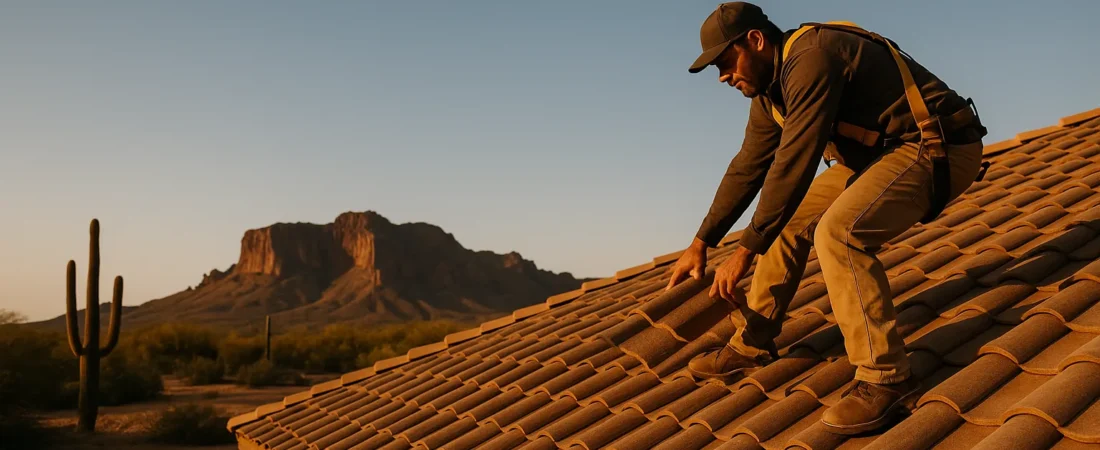
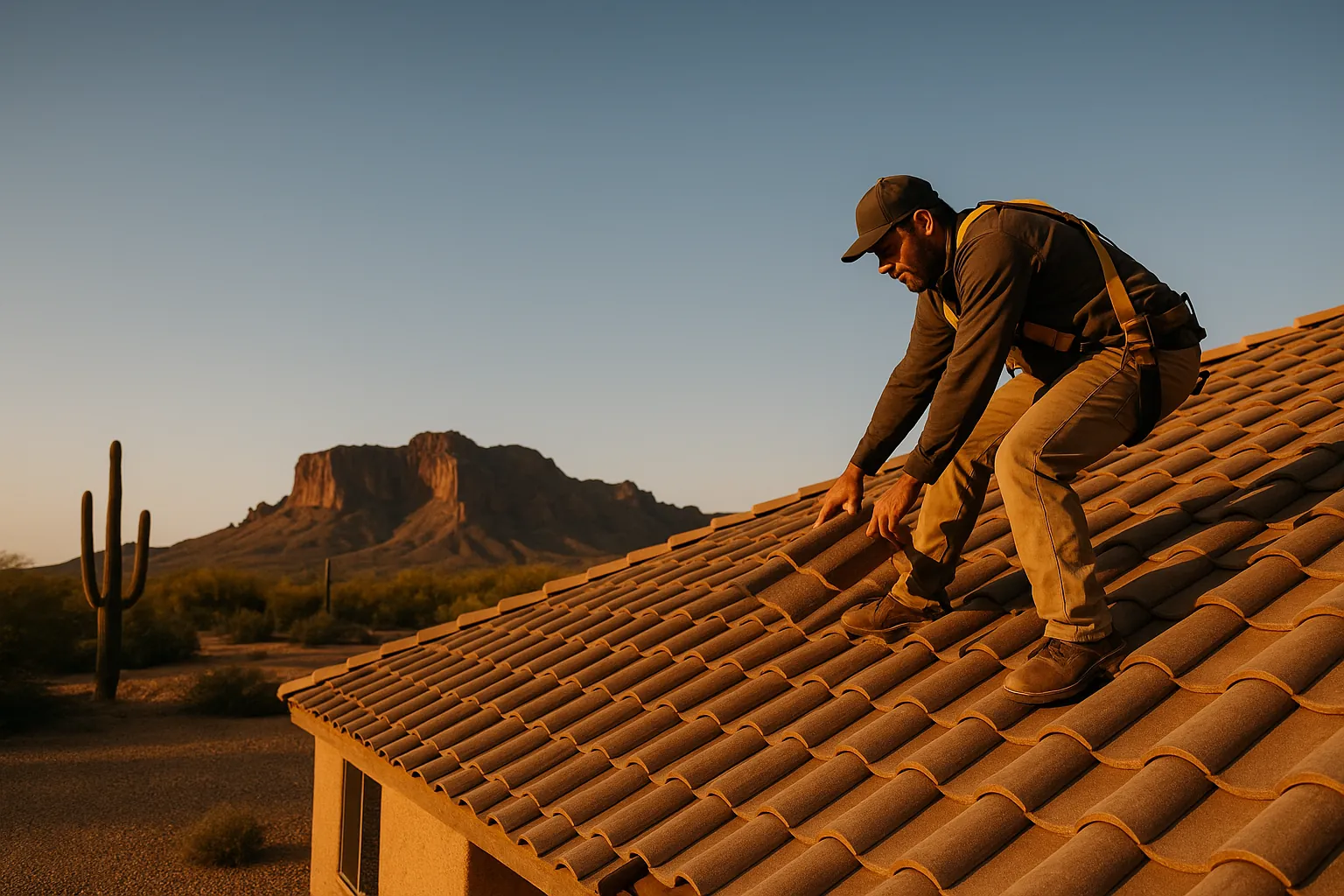
Short answer: Water almost never enters a roof directly above where it appears inside. It gets in at a failure point, then travels along the underside of the decking, down a rafter, or across the top of a ceiling until it finds somewhere to drop. So a stain in the middle of a bedroom ceiling can come from a flashing failure ten feet away and higher up the slope. Finding the actual entry point, rather than patching above the stain, is the entire job. On Arizona roofs the usual sources are failed underlayment, flashing at walls and penetrations, cracked parapet stucco, and coating that has weathered out.
The instinct when a ceiling stains is to look straight up and assume the hole is there. It very rarely is, and that assumption is why some roofs get “repaired” three times for the same leak.
Why water does not fall straight down
Once water gets past the roof surface, it lands on the underside of the roof deck or on top of the insulation. Neither of those is flat and neither is watertight, so the water follows whatever path is easiest.
It runs along the underside of the sheathing until it hits a nail, a seam, or a low point. It runs down the side of a rafter. It pools on top of a ceiling until the drywall gives up in the weakest spot, often at a light fitting or a seam, because those are where the ceiling is thinnest.
By the time you see a drip, that water may have traveled several feet horizontally and dropped through two levels of structure. Which is why the ceiling stain tells you almost nothing about where the roof failed, only where the water finally ran out of options.
This is the single most useful thing a homeowner can know about roof leaks, because it explains why a patch over the stain usually does not work.
Where Arizona roofs actually leak
The entry point depends heavily on what kind of roof you have, and the East Valley has three common types.
| Roof type | Where leaks usually start |
|---|---|
| Tile | The underlayment beneath the tile, not the tile itself. Also valley metal, headwall and sidewall flashing, and cracked ridge mortar |
| Flat or foam | Failed seams, blistering, blocked scuppers causing ponding, parapet wall cracks, and coating worn through by UV |
| Shingle | Flashing at penetrations and walls, wind-lifted or missing shingles, failed vent boots, and valleys |
| All types | Anything that interrupts the roof surface: vents, pipes, skylights, swamp cooler stands, satellite mounts, solar attachment points |
Notice how much of that column is not the roofing material at all. Most leaks happen at interruptions and edges rather than in the middle of a sound roof field. Penetrations, walls, valleys and terminations are where the movement is, and movement is what opens gaps.
The tile roof point that catches everyone
On a tile roof, the tile is not the waterproofing. It is a rain shield. The layer that actually keeps water out is the underlayment stapled to the deck underneath.
Concrete and clay tile lasts for decades. The underlayment beneath it does not, particularly in Arizona heat, where it bakes under the tile for years until it goes brittle and cracks.
So a tile roof can have perfect-looking tiles and leak steadily. If your roof is tile and it has started leaking in more than one unrelated place, that pattern usually points at underlayment reaching the end of its life rather than a series of coincidences. Our tile roofing page covers what that involves.
The flat and foam roof point
On a coated foam roof, the coating is a sacrificial layer protecting the foam from ultraviolet light. When it thins or wears through at high-traffic spots, the foam underneath starts to degrade and the clock speeds up. Ponding water accelerates all of it. Flat and foam roofing goes into the systems themselves.
Why leaks show up in monsoon season
Two reasons, and neither is really about the storm.
Wind-driven rain behaves differently. Ordinary rain falls vertically and a roof sheds it easily. Monsoon rain arrives sideways, and it gets pushed under tile courses, behind flashing, and past terminations that handle vertical water without complaint. A roof that never leaked in a gentle winter rain can leak in a July storm, and that is genuinely informative: it usually means flashing or underlayment is marginal rather than that the storm was exceptional.
And the damage was already done. Months of intense UV and daily thermal cycling, where a roof surface swings from extremely hot in the afternoon to much cooler overnight, opens seams and fatigues flashing all through spring and early summer. The storm does not create those gaps. It finds them.
Which is why the most useful time to have a roof looked at in the East Valley is before monsoon season rather than during it.
How a leak actually gets found
A real diagnosis works backwards from the evidence.
- Start inside. Where exactly is the stain, and what is above it structurally? Attic access, where it exists, is the most useful thing available, because water trails, rusted nails and stained decking show the path
- Work uphill from there. Water runs down, so the entry point is always at or above the interior evidence, never below it
- Check the interruptions first. Penetrations, flashing, valleys, walls, parapets. That is where most leaks are
- Check the terminations. Edges, eaves, and where the roof meets anything vertical
- Then look at the field. Cracked tiles, lifted shingles, blistered membrane, worn coating
- Confirm before repairing. Guessing costs the homeowner a second visit
The step people skip is the first one. A technician who goes straight onto the roof without looking at where the water appeared inside is working blind.
What a proper repair includes
- Fixing the actual entry point, rebuilt properly rather than smeared with sealant
- Checking whether the decking is wet or damaged. Water that has been getting in for a while may have compromised the sheathing, and covering that over stores up a much larger job
- Addressing what allowed it, such as a blocked scupper or a valley packed with debris. Fix the leak and leave the cause and you will be back
- Checking for other marginal spots while up there, because a roof that failed in one place at fifteen years is rarely perfect everywhere else
Sealant over a stain is not a repair. It is a way of postponing the diagnosis.
When a repair is not the answer
Sometimes the honest answer is that repairing is spending money to delay a decision:
- Leaks appearing in unrelated areas over a year or two. That pattern points at the whole waterproofing layer being at the end of its life
- A tile roof past twenty years on original underlayment with its first leaks starting
- A foam roof where the coating is gone across the field rather than worn in one spot
- Decking damage from long-term saturation, where the structure needs attention before anything goes back on top
In those cases roof replacement is the actual fix. A contractor who quotes a patch on a roof in that condition is not doing you a favor.
If the damage came from a storm rather than age, it may be a claim rather than a repair bill, and our insurance claims page covers how that documentation works.
Frequently asked questions
Why is my ceiling stain not directly under the roof leak?
Because water travels once it gets in. It runs along the underside of the decking, down rafters, or across the top of the ceiling before dropping through the weakest point, often a seam or a light fitting. The entry point is usually higher up the slope and can be several feet away.
Can a roof leak if the tiles look fine?
Yes, and on tile roofs it is the most common situation there is. Tile is a rain shield over the underlayment, and the underlayment is what actually keeps water out. Brittle, cracked underlayment under perfectly good tile will leak.
Why does my roof only leak during monsoon storms?
Wind-driven rain gets under tile courses and behind flashing in ways ordinary rain does not. A roof that leaks only in storms usually has marginal flashing or underlayment, so it is worth investigating rather than writing off as a freak weather event.
Should I go up on my roof to look for the leak?
No, particularly on tile. Tile cracks easily when walked on incorrectly, and homeowner inspections regularly create new damage while looking for the old. Check from the ground, and look in the attic if you have safe access.
How urgent is a small roof leak?
More urgent than it looks. The visible drip is the end of the path, so by the time you see it, water has already been in the structure. Wet decking and insulation do not dry out well, and the cost gap between fixing a leak and replacing saturated sheathing is large.
Will my insurance cover a roof leak?
It depends on the cause. Sudden storm damage is treated differently from gradual wear, and policies vary. Documentation from the time of the damage matters a great deal, which is why an inspection report is worth having before a claim rather than after.
Get the source found properly
If you have a stain, a drip, or a roof you are simply not sure about, we will get up there, work out where the water is actually coming in, and tell you whether it is a repair or something bigger. Our roof inspections are free and there is no pressure attached to them.
Call Bloom Roofing at (480) 208-9763 or book a free inspection. AZ ROC # 366703, more than a decade on East Valley rooftops, serving Mesa, Gilbert, Chandler, Tempe, Scottsdale, Queen Creek, San Tan Valley and Apache Junction.
Our roof repair team handles the fix, whether the roof is tile, shingle, or flat and foam.
Wondering what an inspection involves before you book one? We broke down roof inspection cost separately.